
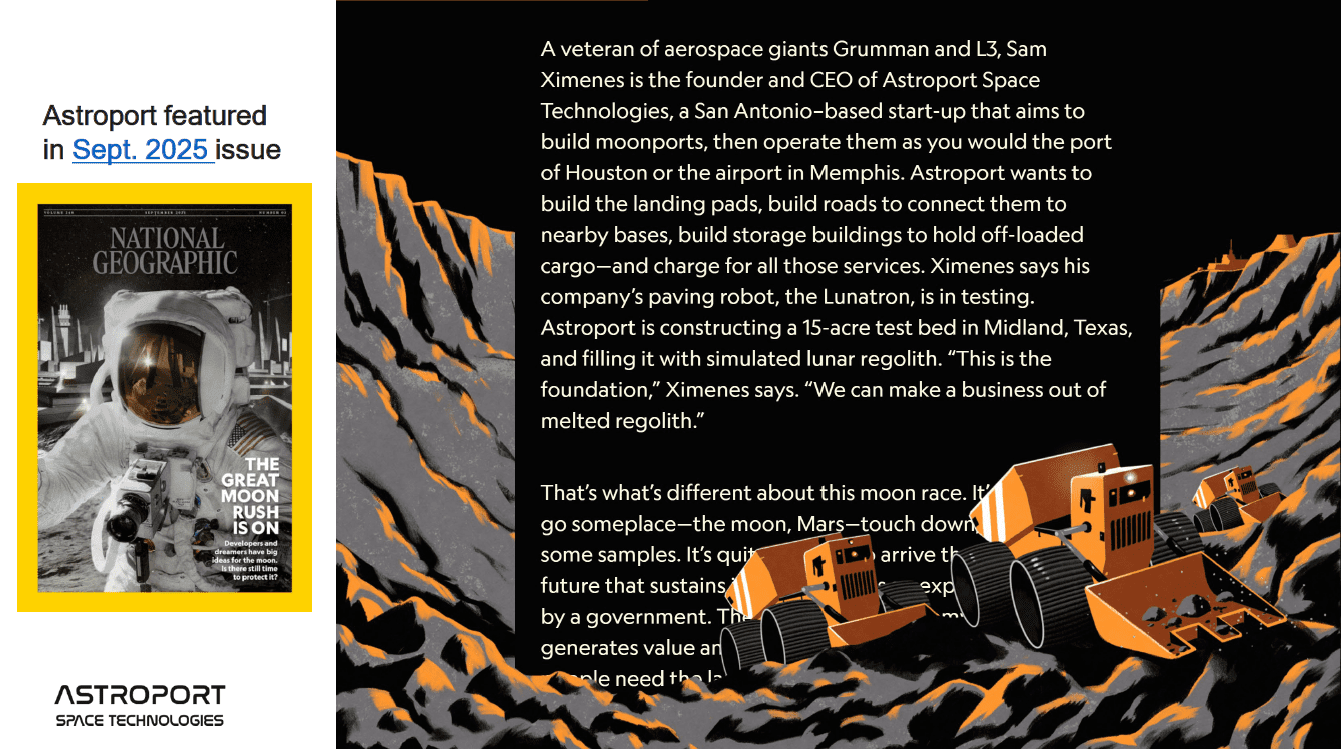

National Geographic, August 15, 2025 — Astroport Space Technologies has been featured by National Geographic in its September 2025 issue, recognizing the company’s work toward enabling long-duration lunar surface operations and space infrastructure development.
Founded in 1888, National Geographic is one of the world’s most respected institutions for science, exploration, engineering, and geographic discovery. Through its magazine, research initiatives, and global storytelling platforms, National Geographic highlights work that advances human understanding of Earth, space, and the systems that support exploration. Its coverage is widely regarded as a benchmark for credibility in science and technology reporting.
The feature highlights Astroport’s vision for treating the Moon not as a one-time destination, but as an operational environment that requires reliable surface preparation, mobility, and systems. As described in the article, Astroport is developing technologies and operational concepts for lunar landing pads, surface roads, and cargo handling infrastructure to support repeatable missions.
National Geographic also notes Astroport’s ongoing testing and validation efforts on Earth, including large-scale regolith simulant testbeds and robotic systems designed to stabilize and condition planetary surfaces. These efforts reflect Astroport’s focus on space civil engineering: building the foundational systems required before habitats, science operations, and commercial activity can scale.
“This kind of acknowledgment matters,” said Sam Ximenes, Founder and CEO of Astroport Space Technologies. “It shows that the conversation around lunar exploration is shifting—from flags and footprints to infrastructure, operations, and long-term sustainability.”
Astroport’s work aligns with a broader global push toward permanent human and robotic presence on the Moon, emphasizing infrastructure that enables economic activity, mission resilience, and future exploration. The National Geographic feature underscores the growing recognition that the next phase of space exploration will be defined not only by where humanity goes—but by what is built to support lasting operations once we arrive.