
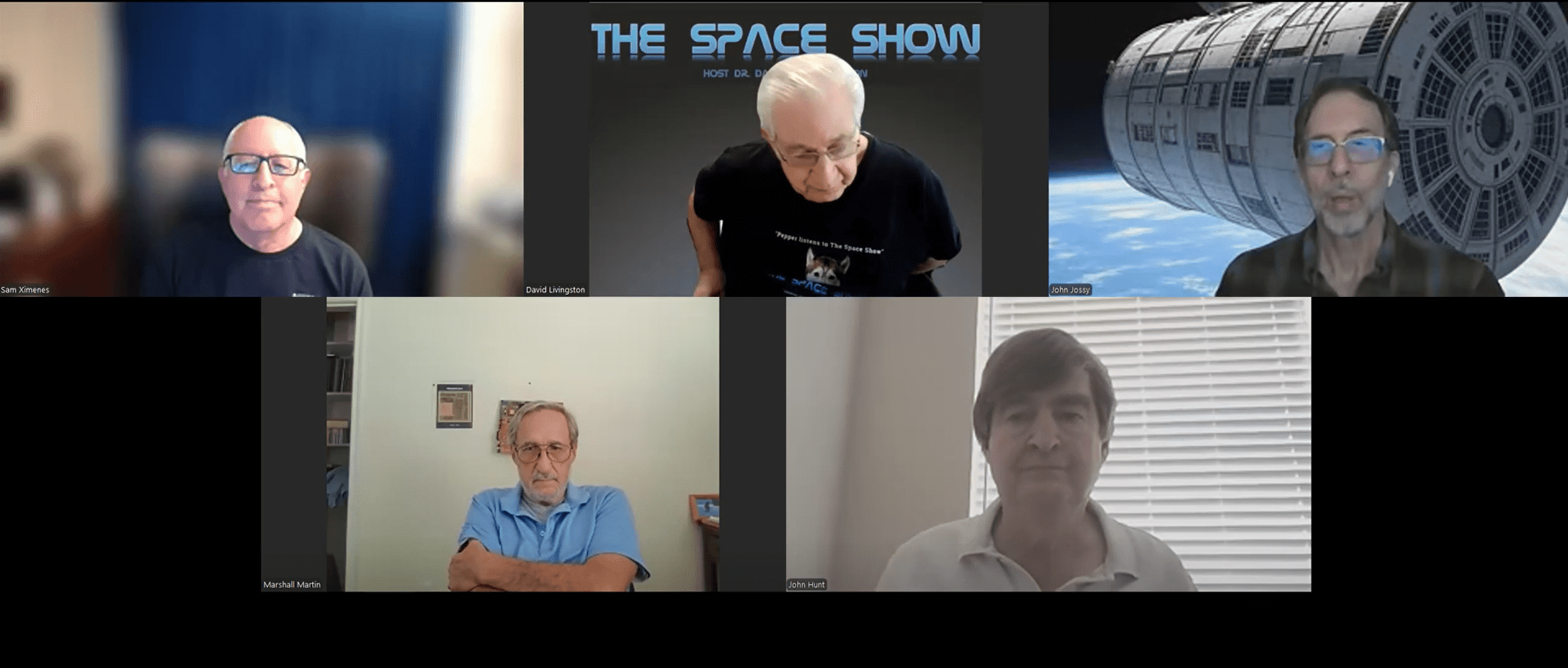
The Space Show, Oct. 20, 2025 — Astroport Founder and CEO Sam Ximenes recently joined a long-form discussion on The Space Show, a nonprofit webcast produced by the One Giant Leap Foundation. The conversation focused on the evolution of lunar development over the past two decades and the technical, economic, and operational realities of building sustained infrastructure on the Moon.
The discussion was moderated by David Livingston and featured a knowledgeable group of participants, including John Jossy, John Hunt, Bill Gowan, Marshall Martin, and Ajay Kothari.
A major theme of the discussion was how reduced launch costs—driven largely by commercial launch providers—have reshaped what is feasible in space architecture. Sam outlined how this shift has enabled more realistic planning for lunar civil engineering, including landing pads, surface logistics, and autonomous construction systems. He also emphasized that while launch has become cheaper, surface operations, power generation, and construction remain the dominant challenges for establishing a permanent lunar presence.
Sam walked through Astroport’s approach to lunar surface development, including plans for a large terrestrial testbed in West Texas to simulate lunar construction conditions. He discussed the company’s focus on treating lunar infrastructure as a civil engineering problem—requiring geotechnical analysis, material science, power planning, and logistics coordination—rather than a single-mission hardware effort. Topics included standardized cargo containers, autonomous construction equipment, and the sequencing of surface operations prior to human arrival.
Power generation and distribution featured prominently in the conversation. Sam described Astroport’s assumptions around power requirements for brickmaking, surface preparation, and broader infrastructure tasks, noting that different activities impose very different energy demands. The group explored concepts such as portable solar towers, reactor siting at safe distances from habitation zones, and the sequencing of power infrastructure relative to landing pad construction. Landing pad design itself was discussed in detail, including size, geometry, material thickness, and the challenges of producing durable construction materials in a vacuum environment.
The discussion also covered broader programmatic considerations, including funding models, regulatory and licensing challenges, and the role of NASA as an anchor customer for early lunar infrastructure. Sam explained Astroport’s current reliance on NASA and Department of Defense contracts for R&D, while outlining how future commercial customers may emerge as lunar operations mature. The group examined how Phase III transitions, regulatory frameworks, and international competition—particularly with China—will shape the pace and direction of lunar development.
Astroport appreciates the opportunity to participate in conversations like this and to engage with a community that has consistently supported thoughtful, technically grounded dialogue on space exploration and settlement.