



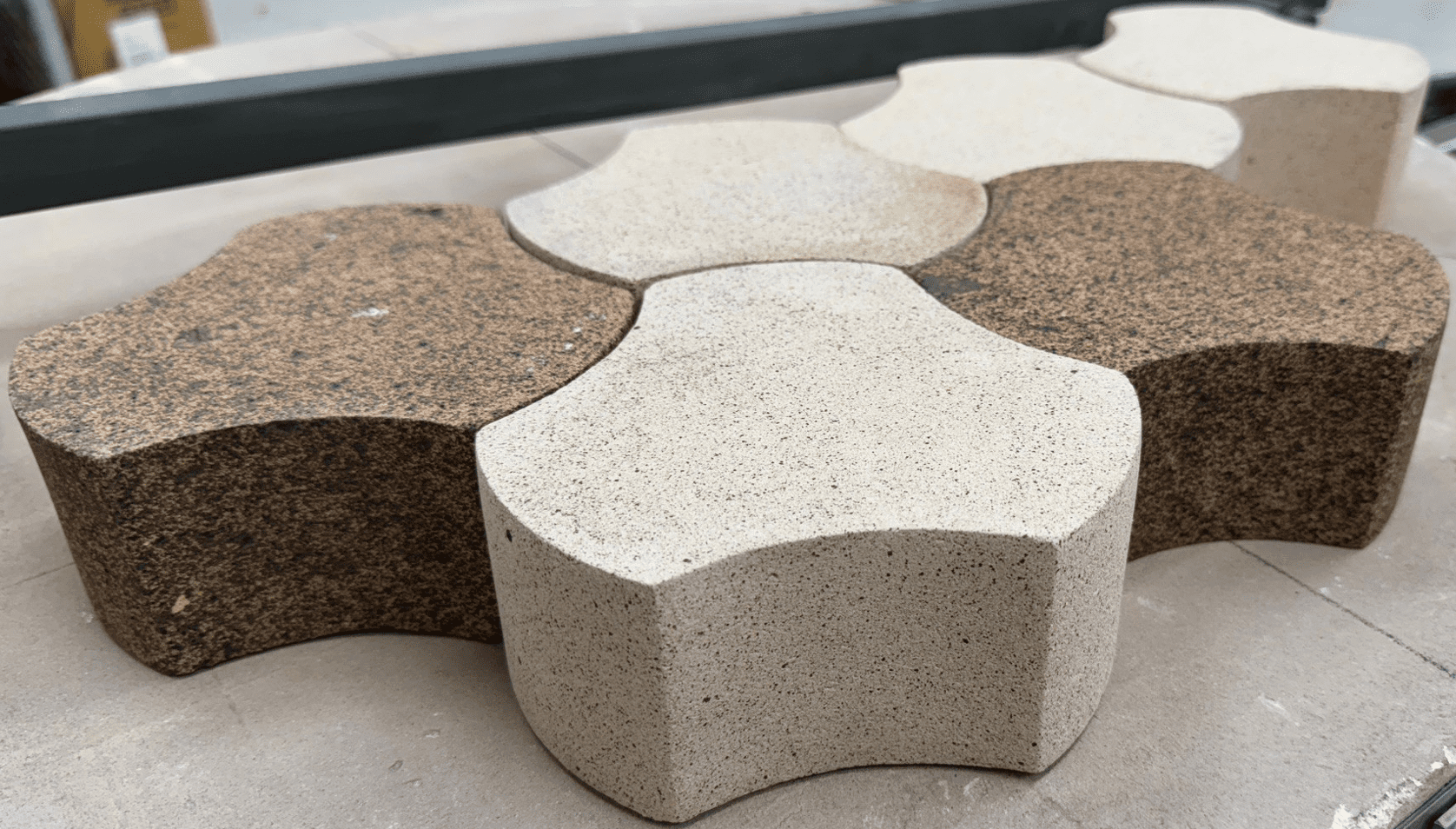
San Antonio, TX, January 2026 -- Between 2024 and 2025, Astroport Space Technologies advanced key regolith conveyance and feed system capabilities under its NASA STTR Phase II Brickbot technology demonstration. This effort builds on Phase I feasibility results and focuses on the controlled acquisition, transport, filtration, and delivery of lunar regolith to a brickmaking furnace as part of an integrated surface construction system.
The Brickbot platform serves as a subscale technology demonstrator for autonomous lunar construction workflows, supporting future development of operational systems for landing pad and surface infrastructure fabrication using in-situ resources.
Key Technical Outcomes
The Conveyance effort addresses the reliable preparation and delivery of regolith feedstock at controlled grain sizes suitable for lunar brick formation, a fundamental requirement for lunar surface construction. The technical scope of this milestone includes:
- Autonomous regolith acquisition and deposit
- Mechanical filtration and grain size optimization for lunar brick strength
- Regolith feed interface to a furnace-nozzle system for brick molding and placement
- Fabrication of a gantry system for robotic brick placement
- Definition of operational procedures and system interfaces
Key Technical Accomplishments
During this milestone period, Astroport completed and validated multiple Phase I closeout and early Phase II objectives, including:
- Development of a Concept of Operations (CONOPS) defining system requirements and procedures for regolith acquisition, filtration, furnace feeding, navigation, power management, communications, and remote command and monitoring.
- Fabrication and integration of two RASSOR-style bucket drums for regolith acquisition and deposit into the onboard filtration system.
- Laboratory and subsystem-level demonstrations validating mechanical filtration performance and material flow behavior through the conveyance and feed architecture.
- Verification of mechanical interface compatibility between the regolith conveyance system and the brickmaking furnace-nozzle feed inlet.
- Initial characterization of power, control, and operational constraints associated with continuous regolith handling.
The second, mass-reduced bucket drum design is under fabrication to further refine system performance and mobility integration in early 2026.
Ongoing Phase II Development
Phase II development continues toward full system integration and functional demonstration of the complete Brickbot platform. Current and planned activities include:
- Integration of the complete regolith acquisition and deposit system
- Finalization and testing of the mechanical filtration and feed subsystems
- Integration of the furnace-nozzle system with the Brickbot platform
- Development of supporting power, thermal management, and command-and-control subsystems
- Functional testing in a simulated lunar terrain environment
These activities are directed toward demonstrating a closed-loop regolith handling and brick production workflow suitable for scaling to future lunar surface operations.
Relevance to Lunar Surface Construction
This milestone supports long-term lunar exploration and infrastructure objectives by advancing the readiness of regolith conveyance and feed systems required for in-situ construction. Controlled preparation and delivery of regolith feedstock is a prerequisite for autonomous brick production, surface stabilization, and infrastructure deployment. The Brickbot platform provides a risk-reduction testbed for these capabilities and informs the design of future operational lunar construction systems.
NASA Disclaimer
The material is based upon work supported by NASA under Contract No. 80NSSC25CA021. Any opinions, findings, and conclusions or recommendations expressed in this material are those of the author(s) and do not necessarily reflect the views of the National Aeronautics and Space Administration.