



San Antonio, TX [2024-2025] — Enabling Fission Surface Power Through Lunar Site Preparation
Ongoing Technical Progress Under NASA STTR Phase II (2024–Present)
Since 2020, Astroport Space Technologies has built a focused portfolio of lunar surface construction and site preparation capabilities through multiple NASA Small Business Technology Transfer (STTR) efforts. This work culminates in the current Phase II effort STTR centered on lunar site preparation Concepts of Operations (ConOps), with a specific emphasis on enabling early deployment and long-term operation of Fission Surface Power (FSP) systems.
Power-First Lunar Infrastructure Strategy
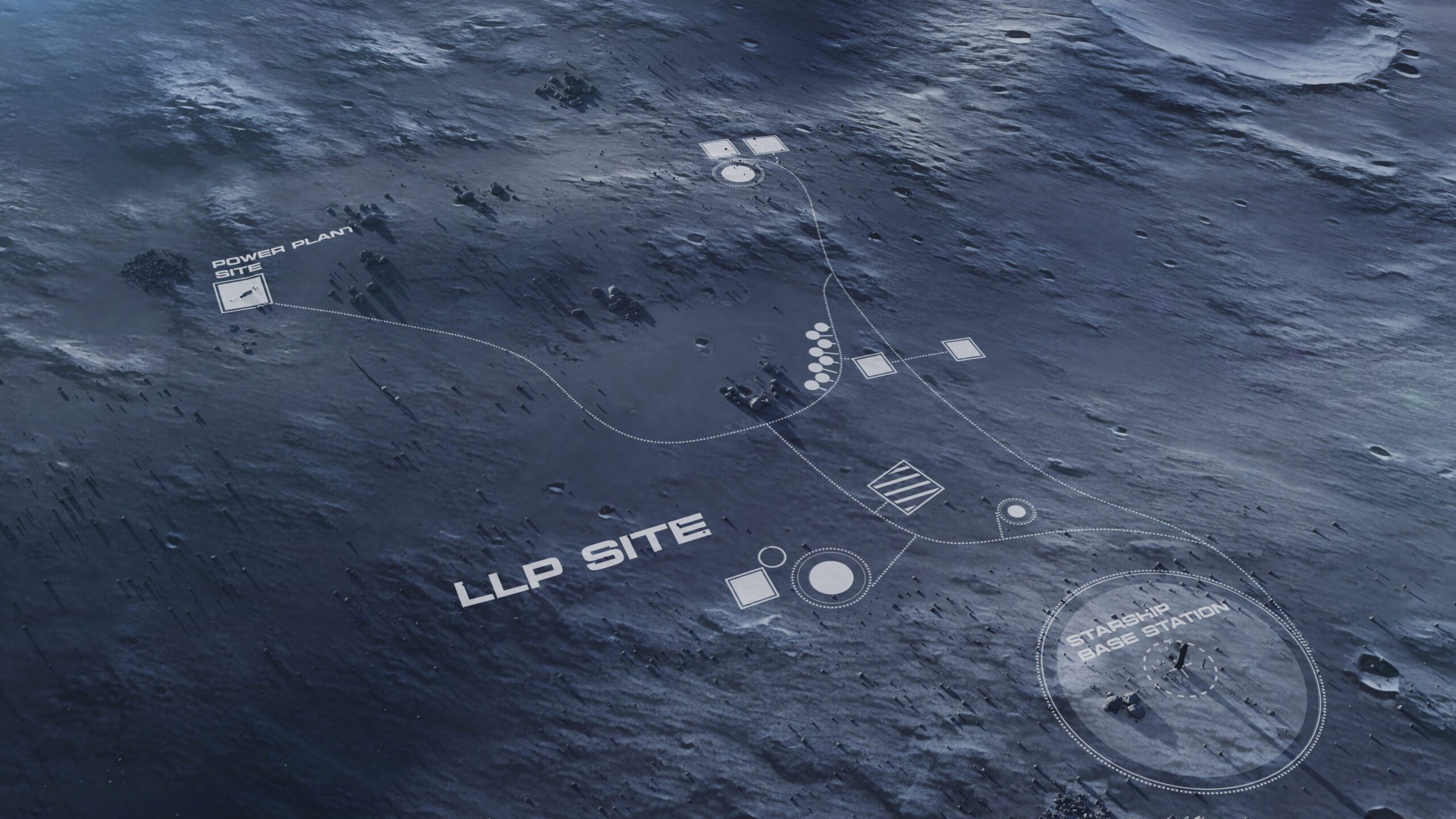
Sustained lunar operations depend on continuous, high-capacity surface power. Astroport’s current Phase II work advances a power-first approach to lunar infrastructure by defining how autonomous systems prepare and stabilize lunar terrain to support early emplacement of surface nuclear reactors. The effort focuses on the operational steps required to ready reactor sites ahead of deployment, including grading and conditioning terrain, constructing hardened vaults and protective berms, and managing dust, ejecta, and other surface hazards that threaten high-value power assets. These site preparation activities are integrated with the sequencing of landing pads, power distribution systems, and future expansion infrastructure, ensuring that reactor deployment is not treated as a standalone event but as the foundational element of a larger, power-enabled surface architecture.
By addressing these challenges at the space civil engineering level, Astroport reduces risk to both the reactor and adjacent surface systems while enabling construction activity to continue through the lunar night under continuous nuclear power.
Key Technical Outcomes
As part of its ongoing NASA STTR Phase II portfolio, Astroport has achieved the following milestones:
- Integrated Site Preparation ConOps: Developed end-to-end operational concepts describing how undeveloped lunar terrain transitions into permanent infrastructure supporting reactors, landing pads, and surface mobility.
- FSP-Centered Site Architecture: Defined site layouts and operational sequencing that prioritize early reactor deployment, radiation shielding, and safe standoff distances while enabling efficient power delivery to surface assets.
- Autonomous Construction and Regolith Handling Concepts: Advanced concepts for robotic excavation, compaction, berm construction, and regolith-based materials processing in direct support of reactor protection and landing surface stabilization.
- Risk Reduction for Artemis and Beyond: Identified and mitigated first-order risks associated with plume-surface interaction, dust transport, and infrastructure survivability in proximity to nuclear power systems.
Connecting Past Work to Sustained Lunar Return
Astroport’s site preparation work directly supports NASA’s long-term objectives for sustained lunar presence by establishing practical, repeatable methods for deploying power and infrastructure simultaneously. Continuous nuclear power enables continuous construction operations, large-scale regolith processing, and safe reusable landing sites, all of which are prerequisites for permanent lunar operations.
This ongoing effort builds on Astroport’s earlier STTR work in robotic construction, regolith processing, and surface operations, forming a coherent technical progression toward industrial-scale lunar development aligned with national goals for a sustained return to the Moon by 2030.
NASA Disclaimer
The material is based upon work supported by NASA under Contract No. 80NSSC24CA021. Any opinions, findings, and conclusions or recommendations expressed in this material are those of the author(s) and do not necessarily reflect the views of the National Aeronautics and Space Administration.
Check out the NASA award page here
Visit local Press Releases about these awards here